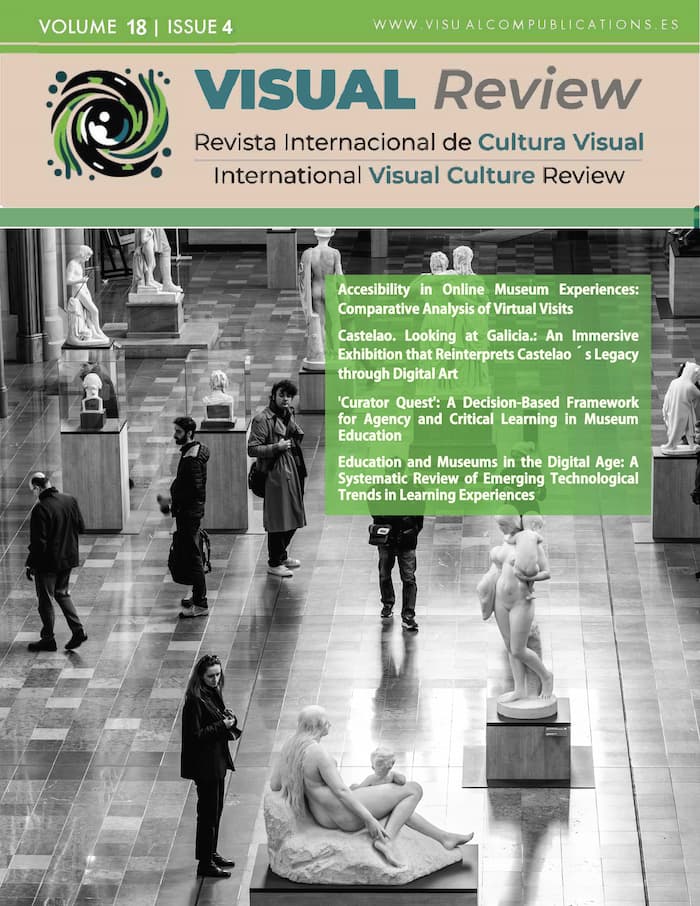
Educación en museos en la era digital
Revisión sistemática de las tendencias tecnológicas emergentes en las experiencias de aprendizaje
DOI:
https://doi.org/10.62161/revvisual.v18.6245Palabras clave:
Aprendizaje, Educación museística, Innovación educativa, Inteligencia artificial, Museo inteligente, Realidad aumentada, Realidad virtualResumen
La literatura sobre educación museística y tecnologías digitales presenta un desarrollo fragmentado y carente de síntesis integradoras. El objetivo de este estudio fue analizar y categorizar la evidencia científica reciente sobre tecnologías emergentes aplicadas a la educación museística, aportes pedagógicos y direcciones futuras. Se realizó una revisión sistemática siguiendo PRISMA, mediante búsquedas en Scopus y Web of Science, seleccionándose 42 estudios por su relevancia temática. Los hallazgos evidencian la predominancia de museos virtuales, realidad aumentada y realidad virtual, con aportes pedagógicos diferenciados en accesibilidad, inmersión, personalización y engagement. Se transita hacia un ecosistema de aprendizaje inclusivos, inmersivos y personalizados con dimensiones tecnológicas, pedagógicas e institucionales, y se discuten oportunidades para investigaciones futuras.
Descargas
Estadísticas globales ℹ️
|
807
Visualizaciones
|
417
Descargas
|
|
1224
Total
|
|
Citas
Adams, J. D. (2007). The historical context of science and education at the American Museum of Natural History. Cultural Studies of Science Education, 2(2), 393-440. Scopus. https://doi.org/10.1007/s11422-007-9059-8 DOI: https://doi.org/10.1007/s11422-007-9059-8
Arayaphan, W., Sirasakmol, O., Nadee, W., & Puritat, K. (2022). Enhancing Intrinsic Motivation of Librarian Students using Virtual Reality for Education in the Context of Culture Heritage Museums. TEM Journal, 11(2), 620-630. Scopus. https://doi.org/10.18421/TEM112-16 DOI: https://doi.org/10.18421/TEM112-16
Bakker, F. T., Antonelli, A., Clarke, J. A., Cook, J. A., Edwards, S. V., Ericson, P. G. P., Faurby, S., Ferrand, N., Gelang, M., Gillespie, R. G., Irestedt, M., Lundin, K., Larsson, E., Matos-Maraví, P., Müller, J., von Proschwitz, T., Roderick, G. K., Schliep, A., Wahlberg, N., … Källersjö, M. (2020). The global museum: Natural history collections and the future of evolutionary science and public education. PeerJ, 8. Scopus. https://doi.org/10.7717/peerj.8225 DOI: https://doi.org/10.7717/peerj.8225
Balshem, H., Helfand, M., Schünemann, H. J., Oxman, A. D., Kunz, R., Brozek, J., Vist, G. E., Falck-Ytter, Y., Meerpohl, J., Norris, S., & Guyatt, G. H. (2011). GRADE guidelines: 3. Rating the quality of evidence. Journal of Clinical Epidemiology, 64(4), 401-406. https://doi.org/10.1016/j.jclinepi.2010.07.015 DOI: https://doi.org/10.1016/j.jclinepi.2010.07.015
Berardinetti, V., Peconio, G., Rossi, M., & Toto, G. A. (2025). Museum Education Meets Digital Technologies: Impacts on Teaching and Teacher Training. En P. Ardimento, G. Zaza, R. Di Fuccio, P. Limone, G. Fulantelli, D. Schicchi, D. Taibi, R. Pecori, P. Raviolo, & M. Rondonotti (Eds.), Commun. Comput. Info. Sci.: 2467 CCIS (pp. 321-339). Springer Science and Business Media Deutschland GmbH. Scopus. https://doi.org/10.1007/978-3-031-94002-6_24 DOI: https://doi.org/10.1007/978-3-031-94002-6_24
Bolognesi, C., & Aiello, D. (2020). LEARNING through SERIOUS GAMES: A DIGITAL DESIGN MUSEUM for EDUCATION. En S. Kumar, P. L. N. Raju, S. P. Aggarwal, S. R. Reyes, M. Ustuner, F. Tsai, & V. Liesenberg (Eds.), Int. Arch. Photogramm., Remote Sens. Spat. Inf. Sci. - ISPRS Arch. (Vol. 43, Número B5, pp. 83-90). International Society for Photogrammetry and Remote Sensing. Scopus. https://doi.org/10.5194/isprs-archives-XLIII-B5-2020-83-2020 DOI: https://doi.org/10.5194/isprs-archives-XLIII-B5-2020-83-2020
Brown, K. (2026). Artificial Exchange: Chatbots and the Ethics of Museum Experience Design. En Springer Series on Cultural Computing: Part F652 (pp. 247-262). Springer Science and Business Media Deutschland GmbH. https://doi.org/10.1007/978-3-031-89521-0_13 DOI: https://doi.org/10.1007/978-3-031-89521-0_13
Butcher, K. R., Power, M. J., Larson, M., Orr, M. P., Velásquez-Franco, S., Hudson, M. A., & Bailey, V. J. (2021). Museum Leadership for Engaging, Equitable Education: The Transformative Potential of Digitized Collections for Authentic Learning Experiences. Curator, 64(2), 383-402. Scopus. https://doi.org/10.1111/cura.12423 DOI: https://doi.org/10.1111/cura.12423
Carlini, A. (2021). Museum Education Between Digital Technologies and Unplugged Processes. Two Case Studies. En Lect. Notes Networks Syst. (Vol. 240, pp. 155-163). Springer Science and Business Media Deutschland GmbH. Scopus. https://doi.org/10.1007/978-3-030-77040-2_21 DOI: https://doi.org/10.1007/978-3-030-77040-2_21
Ceccacci, S., Agostinelli, T., Giaconi, C., & Mengoni, M. (2026). Exploring the Impact of Virtual Reality Immersion on Visitor Experience and Learning in Museums. Lect. Notes Comput. Sci., 15741 LNCS, 3-17. https://doi.org/10.1007/978-3-031-97775-6_1 DOI: https://doi.org/10.1007/978-3-031-97775-6_1
Cheng, A., Zhang, W., Feng, A., Wu, Y., & Li, W. (2025). Exploring psychological dimensions of augmented reality in education: A study on learning motivation and achievement in museums. Frontiers in Psychology, 16. Scopus. https://doi.org/10.3389/fpsyg.2025.1514117 DOI: https://doi.org/10.3389/fpsyg.2025.1514117
Clover, D. E. (2015). Adult education for social and environmental change in contemporary public art galleries and museums in Canada, Scotland and England. International Journal of Lifelong Education, 34(3), 300-315. Scopus. https://doi.org/10.1080/02601370.2014.993731 DOI: https://doi.org/10.1080/02601370.2014.993731
Dalari, A. (2019). The subject of arts education through the use of new technologies. The case of the virtual museum. Australian Educational Computing, 34(1). Scopus. https://www.scopus.com/inward/record.uri?eid=2-s2.0-85077899729&partnerID=40&md5=29a45b1aaa343fbf50d7c123e9ba91a0
De Carolis, B., MacChiarulo, N., & Bochicchio, M. A. (2023). AI-Assisted Virtual Reality for Cultural Heritage Education: The Experience of the MARTA Museum. En A. Cardoso & M. T. Restivo (Eds.), Exp. Int. Conf., exp.at—Proc. (pp. 152-156). Institute of Electrical and Electronics Engineers Inc. Scopus. https://doi.org/10.1109/exp.at2358782.2023.10545657 DOI: https://doi.org/10.1109/exp.at2358782.2023.10545657
Dumont, C., de Backer, F., Dewinter, H., & Vandermeersche, G. (2025). Museum educators’ views on digital museum education: Opportunities and challenges. Cultural Trends, 34(3), 398-413. Scopus. https://doi.org/10.1080/09548963.2024.2378324 DOI: https://doi.org/10.1080/09548963.2024.2378324
Elbay, S. (2022). Distance education experiences of middle school 7th grade students in the turkey during COVID-19 pandemic: Virtual museum example. Turkish Online Journal of Distance Education, 23(1), 237-256. Scopus.
Erol, M., Erol, A., & Özdemir, F. (2025). Social Studies-Specific Field Skills Acquired by Primary School Students in the Process of Virtual Museum Education. Journal of Museum Education. Scopus. https://doi.org/10.1080/10598650.2025.2454102 DOI: https://doi.org/10.1080/10598650.2025.2454102
Fang, L. (2021). The Application of Digital Media Art in Art Museum Public Education Based on Human-Computer Interaction Technology. Proc. - Int. Conf. Inf. Sci. Educ., ICISE-IE, 1424-1427. Scopus. https://doi.org/10.1109/ICISE-IE53922.2021.00317 DOI: https://doi.org/10.1109/ICISE-IE53922.2021.00317
Fedotova, O., Zhurakovskij, V., Ermakov, P., Cherkashin, I., & Cherkashina, E. (2021). Virtual museum in the system of informal education (based on sports materials). En D. Rudoy, A. Olshevskaya, & N. Ugrekhelidze (Eds.), E3S Web Conf. (Vol. 273). EDP Sciences. Scopus. https://doi.org/10.1051/e3sconf/202127312072 DOI: https://doi.org/10.1051/e3sconf/202127312072
Ferrer-Yulfo, A. (2022). Transforming Museum Education Through Intangible Cultural Heritage. Journal of Museum Education, 47(3), 319-330. Scopus. https://doi.org/10.1080/10598650.2022.2080966 DOI: https://doi.org/10.1080/10598650.2022.2080966
Fevgas, A., Fraggogiannis, N., Tsompanopoulou, P., & Bozanis, P. (2014). The iMuse virtual museum: Towards a cultural education platform. IISA - Int. Conf. Inf., Intell., Syst. Appl., 171-175. Scopus. https://doi.org/10.1109/IISA.2014.6878817 DOI: https://doi.org/10.1109/IISA.2014.6878817
Galuban, B. A., & Green, J. S. (2026). Dwelling With: Centering Care and Contemplative Practice in Museum Education. Journal of Museum Education. Scopus. https://doi.org/10.1080/10598650.2025.2604337 DOI: https://doi.org/10.1080/10598650.2025.2604337
García, J. A. A., Reyes, M. A. S., & Villamizar, A. M. B. (2023). Virtual Museum and art education Pedagogical Route for the dissemination of school art. Human Review. International Humanities Review / Revista Internacional de Humanidades, 16(5). Scopus. https://doi.org/10.37467/revhuman.v12.4678 DOI: https://doi.org/10.37467/revhuman.v12.4678
Geselowitz, M., & Breitfelder, K. (2002). The IEEE virtual museum: Using Web-based education and a humanistic approach to promote engineering at the K-12 level. ASEE Annu. Conf. Proc., 6873-6880. Scopus. https://www.scopus.com/inward/record.uri?eid=2-s2.0-8744275258&partnerID=40&md5=a9fc70a898c81fbb1c4c7057ca0758e6
Gómez, M. R. B., Fernández-Samacá, L. F., & Díaz, A. L. A. (2025). Immersive Technologies for Engineering Education: A Virtual Reality Experience at the UPTC Geology Museum. En D. Mesquita, V. Villas-Boas, & R. M. Lima (Eds.), Int. Symposium Project Approaches Eng. Educ. (Vol. 15, pp. 129-137). University of Minho. Scopus. https://doi.org/10.5281/zenodo.15850160
Guazzaroni, G., & Pillai, A. S. (2019). Virtual and augmented reality in education, art, and museums. En Virtual and Augment. Real. In Educ., Art, and Mus. (p. 385). IGI Global. Scopus. https://doi.org/10.4018/978-1-7998-1796-3 DOI: https://doi.org/10.4018/978-1-7998-1796-3
Güler, B., & Cengiz, E. (2025). Science education in virtual museums: Effects on attitudes and motivation towards science courses. International Journal of Science Education. Scopus. https://doi.org/10.1080/09500693.2025.2557607 DOI: https://doi.org/10.1080/09500693.2025.2557607
Hansson, P., & Öhman, J. (2022). Museum education and sustainable development: A public pedagogy. European Educational Research Journal, 21(3), 469-483. Scopus. https://doi.org/10.1177/14749041211056443 DOI: https://doi.org/10.1177/14749041211056443
Hernández Guzmán, D. H., Muñoz, P. C., & Duarte, N. R. (2024). Augmented Reality for Civic Education within Makerspace Museums. En E. Shakshuki (Ed.), Procedia Comput. Sci. (Vol. 231, pp. 184-189). Elsevier B.V. Scopus. https://doi.org/10.1016/j.procs.2023.12.191 DOI: https://doi.org/10.1016/j.procs.2023.12.191
Hooper-Greenhill, E. (2007). Museums and education: Purpose, pedagogy, performance. En Museums and Educ.: Purp., Pedagog., Perform. (p. 231). Routledge Taylor & Francis Group. Scopus. https://doi.org/10.4324/9780203937525 DOI: https://doi.org/10.4324/9780203937525
Huebner, E. J. (2022). TikTok and museum education: A visual content analysis. International Journal of Education Through Art, 18(2), 209-225. Scopus. https://doi.org/10.1386/eta_00095_1 DOI: https://doi.org/10.1386/eta_00095_1
Huebner, E. J. (2023). Museum Education Through Social Media. Studies in Art Education, 64(4), 445-466. Scopus. https://doi.org/10.1080/00393541.2023.2255083 DOI: https://doi.org/10.1080/00393541.2023.2255083
Ismaeel, D. A., & Al-Abdullatif, A. M. (2016). The impact of an interactive virtual museum on students’ attitudes toward cultural heritage education in the region of Al Hassa, Saudi Arabia. International Journal of Emerging Technologies in Learning, 11(4), 32-39. Scopus. https://doi.org/10.3991/ijet.v11i04.5300 DOI: https://doi.org/10.3991/ijet.v11i04.5300
Jun, J. Z., & Bin, W. Z. (2011). Ideas transforming in the public arts education of virtual museum. ICCSE - Int. Conf. Comput. Sci. Educ., Final Program Proc., 649-653. Scopus. https://doi.org/10.1109/ICCSE.2011.6028722 DOI: https://doi.org/10.1109/ICCSE.2011.6028722
Kahveci, N. G. (2025). Exploring virtual museums: Pre-service teachers’ experiences of virtual museums in gifted and talented education. Curator, 68(1), 201-218. Scopus. https://doi.org/10.1111/cura.12647 DOI: https://doi.org/10.1111/cura.12647
Kristinsdóttir, A. (2017). Toward sustainable museum education practices: Confronting challenges and uncertainties. Museum Management and Curatorship, 32(5), 424-439. Scopus. https://doi.org/10.1080/09647775.2016.1250104 DOI: https://doi.org/10.1080/09647775.2016.1250104
Lee, J., Lee, H.-K., Jeong, D., Lee, J., Kim, T., & Lee, J. (2021). Developing Museum Education Content: AR Blended Learning. International Journal of Art and Design Education, 40(3), 473-491. Scopus. https://doi.org/10.1111/jade.12352 DOI: https://doi.org/10.1111/jade.12352
Li, Z. (2013). Reinforcing science education using virtual museums in China. Proc. PICMET: Technol. Manage. IT-Driven Serv., 1254-1257. Scopus. https://www.scopus.com/inward/record.uri?eid=2-s2.0-84890838717&partnerID=40&md5=4a031950c7a2120619c9eb2db4052238
Lin, W., & Hu, X. (2025). GenAI-Supported Creative Learning in Digital Museum Education: A Case Study of Maritime Art Painting Creation. Conf Hum Fact Comput Syst Proc. Scopus. https://doi.org/10.1145/3706599.3719910 DOI: https://doi.org/10.1145/3706599.3719910
Llamazares de Prado, J. E., & Arias-Gago, A. R. (2023). Education and ICT in Inclusive Museums Environments. International Journal of Disability, Development and Education, 70(2), 186-200. Scopus. https://doi.org/10.1080/1034912X.2020.1856350 DOI: https://doi.org/10.1080/1034912X.2020.1856350
Lӧseke, A. (2022). FROM TRANSCULTURAL ENTANGLEMENTS TO INTEGRATED LEARNING EXPERIENCES? TRANSCULTURAL MUSEUM EDUCATION AT BERLIN’S MUSEUM OF ISLAMIC ART. Journal of Elementary Education, 15, 115-131. Scopus. https://doi.org/10.18690/REI.15.SPEC.ISS.115-131.2022 DOI: https://doi.org/10.18690/rei.15.Spec.Iss.115-131.2022
Maipas, S., Konstantinidou, A., Lazaris, A. C., & Kavantzas, N. (2021). Environmental Health Education: From Museum Specimens and Math Word Problems to Virtual and Augmented Reality. Environmental Health Insights, 15. Scopus. https://doi.org/10.1177/11786302211066355 DOI: https://doi.org/10.1177/11786302211066355
Malyshev, Y. N., & Titova, A. V. (2020). Modern approaches to sectorial education in geology and mining via museum activities and digital technologies. Gornyi Zhurnal, 2020(12), 95-100. Scopus. https://doi.org/10.17580/gzh.2020.12.22 DOI: https://doi.org/10.17580/gzh.2020.12.22
Mayer, M. M. (2005). Bridging the Theory-Practice Divide in Contemporary Art Museum Education. Art Education, 58(2), 13-17. Scopus. https://doi.org/10.1080/00043125.2005.11651530 DOI: https://doi.org/10.1080/00043125.2005.11651530
Menegaki, A. N. (2022). New Technologies in Hotels and Museums: Supply-side Perceptions with Education Implications for Managers and Curators. Journal of the Knowledge Economy, 13(4), 2935-2956. Scopus. https://doi.org/10.1007/s13132-021-00849-z DOI: https://doi.org/10.1007/s13132-021-00849-z
Musicco, A. T., & Berardinetti, V. (2025). Empowering Education Through Interactive Social Robots in Museums to Enhance Soft Skills and Meaningful Learning Experiences: A Literature Review. En G. A. Toto (Ed.), Commun. Comput. Info. Sci.: 2521 CCIS (pp. 51-62). Springer Science and Business Media Deutschland GmbH. Scopus. https://doi.org/10.1007/978-3-032-03021-4_4 DOI: https://doi.org/10.1007/978-3-032-03021-4_4
Nguyen, T. C. (2026). The collaboration of artificial intelligence (AI) and museums: Possible or impossible? Journal of Community Archaeology and Heritage. https://doi.org/10.1080/20518196.2025.2592005 DOI: https://doi.org/10.1080/20518196.2025.2592005
Page, M. J., McKenzie, J. E., Bossuyt, P. M., Boutron, I., Hoffmann, T. C., Mulrow, C. D., Shamseer, L., Tetzlaff, J. M., Akl, E. A., Brennan, S. E., Chou, R., Glanville, J., Grimshaw, J. M., Hróbjartsson, A., Lalu, M. M., Li, T., Loder, E. W., Mayo-Wilson, E., McDonald, S., … Moher, D. (2021). The PRISMA 2020 statement: An updated guideline for reporting systematic reviews. The BMJ, 372. Scopus. https://doi.org/10.1136/bmj.n71 DOI: https://doi.org/10.1136/bmj.n71
Papadamou, T., Gavrilakis, C., Tsolakidis, C., & Liarakou, G. (2010). Education for sustainable development through the use of the second life: The case of a virtual museum for sharks. Commun. Comput. Info. Sci., 73 CCIS, 316-323. Scopus. https://doi.org/10.1007/978-3-642-13166-0_45 DOI: https://doi.org/10.1007/978-3-642-13166-0_45
Piatkowska, K., & Darecka, K. (2026). Restoring the past digitally: A 3D visualization study of the Great Mill in Gdansk. Design Studies, 103. https://doi.org/10.1016/j.destud.2025.101376 DOI: https://doi.org/10.1016/j.destud.2025.101376
Poce, A., Amenduni, F., de Medio, C., Valente, M., & Re, M. R. (2019). Adopting augmented reality to engage higher education students in a Museum University collection: The experience at Roma Tre University. Information (Switzerland), 10(12). Scopus. https://doi.org/10.3390/info10120373 DOI: https://doi.org/10.3390/info10120373
Purssell, E. (2020). Can the Critical Appraisal Skills Programme check-lists be used alongside Grading of Recommendations Assessment, Development and Evaluation to improve transparency and decision-making? Journal of Advanced Nursing, 76(4), 1082-1089. https://doi.org/10.1111/jan.14303 DOI: https://doi.org/10.1111/jan.14303
Puspasari, S., Ermatita, E., & Zulkardi, Z. (2023). Sensitivity Analysis of the New Model of Museum Education Performance Index with Machine Learning-Based Digital Technology Usage Parameters. Int. Conf. Informatics, Multimed., Cyber Inf. Syst., ICIMCIS, 561-565. Scopus. https://doi.org/10.1109/ICIMCIS60089.2023.10349041 DOI: https://doi.org/10.1109/ICIMCIS60089.2023.10349041
Puspasari, S., Suhandi, N., & Iman, J. N. (2020). Augmented Reality Development for Supporting Cultural Education Role in SMB II Museum during Covid-19 Pandemic. Int. Conf. Informatics Comput., ICIC. Scopus. https://doi.org/10.1109/ICIC50835.2020.9288619 DOI: https://doi.org/10.1109/ICIC50835.2020.9288619
Richter, F., Vater, J., Eger-Passos, D., Böttcher, H., Wotte, T., & Jung, B. (2026). 3D Digitization and Immersive XR Applications for Paleontology Education. Lect. Notes Comput. Sci., 15738 LNCS, 236-255. https://doi.org/10.1007/978-3-031-97769-5_19 DOI: https://doi.org/10.1007/978-3-031-97769-5_19
Rivero, P., Monclús, G., & Rubio-Navarro, A. (2023). Edu-Communication from Museums to Formal Education: Cases around Intangible Cultural Heritage and the Co-Creative Paradigm. Heritage, 6(11), 7067-7082. Scopus. https://doi.org/10.3390/heritage6110368 DOI: https://doi.org/10.3390/heritage6110368
Seale, N. (2023). Education, Entertainment, and Engagement in Museums in the Digital Age. En J. Wallace, J. R. Whitson, B. Bonsignore, J. Frommel, & E. Harpstead (Eds.), CHI PLAY - Companion Proc. Ann. Symp. Comput.-Human Interact. Play (pp. 326-329). Association for Computing Machinery, Inc. Scopus. https://doi.org/10.1145/3573382.3616034 DOI: https://doi.org/10.1145/3573382.3616034
Sharma, B., Alhazmi, A., Nasir, N., & Bridget, B. (2026). Innovative Learning in Anatomy Education: Assessing the Impact of Low-Cost 3D Deep Learning Anatomical Models in Museum-Based Instruction. Journal of Surgical Education, 83(1). Scopus. https://doi.org/10.1016/j.jsurg.2025.103748 DOI: https://doi.org/10.1016/j.jsurg.2025.103748
Short, D. B. (2015). Use of 3D printing by museums: Educational exhibits, artifact education, and artifact restoration. 3D Printing and Additive Manufacturing, 2(4), 209-215. Scopus. https://doi.org/10.1089/3dp.2015.0030 DOI: https://doi.org/10.1089/3dp.2015.0030
Singh, J. (2013). Critical appraisal skills programme. Journal of Pharmacology and Pharmacotherapeutics, 4(1), 76-77. https://doi.org/10.4103/0976-500X.107697 DOI: https://doi.org/10.4103/0976-500X.107697
Sun, S. (2024). Research on the Application of Digital Technology in Museum-Based Aesthetic Education of Children. En A. Marcus, E. Rosenzweig, & M. M. Soares (Eds.), Lect. Notes Comput. Sci.: 14715 LNCS (pp. 328-339). Springer Science and Business Media Deutschland GmbH. Scopus. https://doi.org/10.1007/978-3-031-61359-3_23 DOI: https://doi.org/10.1007/978-3-031-61359-3_23
Todino, M. D., & Campitiello, L. (2025). Museum Education. Encyclopedia, 5(1). Scopus. https://doi.org/10.3390/encyclopedia5010003 DOI: https://doi.org/10.3390/encyclopedia5010003
Tran, L. U., Gupta, P., & Bader, D. (2019). Redefining Professional Learning for Museum Education. Journal of Museum Education, 44(2), 135-146. Scopus. https://doi.org/10.1080/10598650.2019.1586192 DOI: https://doi.org/10.1080/10598650.2019.1586192
Ulusoy, K. (2010). Open education students’ perspectives on using virtual museums application in teaching history subjects. Turkish Online Journal of Distance Education, 11(4), 36-46. Scopus.
Vasilev, V. N., Kolesnikov, Yu. L., Chufarov, E. V., Shelamova, T. V., & Shcherbakova, I. Yu. (2005). The virtual museum of the University as a means of studying the history of optical instrumentation and optical education. Journal of Optical Technology (A Translation of Opticheskii Zhurnal), 72(3), 287-290. Scopus. https://doi.org/10.1364/JOT.72.000287 DOI: https://doi.org/10.1364/JOT.72.000287
Vinent Cárdenas, M., Gustems, J., Martín-Piñol, C., & Faure-Carvallo, A. (2026). European Music Museums: Interactive Spaces for Musical Education. Curator, 69(1), 80-92. Scopus. https://doi.org/10.1111/cura.70004 DOI: https://doi.org/10.1111/cura.70004
Wang, L., & Xie, L. (2026). Multi-screen Interactive Systems Based on Multi-touch Point Recognition Algorithm: Application in Museum Children’s Science Education Exhibitions. Lect. Notes Electr. Eng., 1477 LNEE, 253-260. https://doi.org/10.1007/978-981-95-1908-8_32 DOI: https://doi.org/10.1007/978-981-95-1908-8_32
Wei, Z., Zhong, C., & Gao, Y. (2023). Art therapy practices in museum education: A mini review. Frontiers in Psychology, 13. Scopus. https://doi.org/10.3389/fpsyg.2022.1075427 DOI: https://doi.org/10.3389/fpsyg.2022.1075427
Yanar, A., Güneröz, C., & Aksan, E. (2026). Participatory museum education through visual, audio and augmented reality: The toy box experience at Ankara Toy Museum. Humanities and Social Sciences Communications, 13(1). Scopus. https://doi.org/10.1057/s41599-025-06347-w DOI: https://doi.org/10.1057/s41599-025-06347-w
Yang, K., & Wang, H. (2023). The Application of Interactive Humanoid Robots in the History Education of Museums under Artificial Intelligence. International Journal of Humanoid Robotics, 20(6). Scopus. https://doi.org/10.1142/S0219843622500165 DOI: https://doi.org/10.1142/S0219843622500165
Ying, Z., Yang, Y., Chai, C., Mo, C., & Zhang, Z. (2019). The development and performance evaluation of digital museums towards second classroom of primary and secondary school—Taking Zhejiang Education Technology Digital Museum as an example. International Journal of Emerging Technologies in Learning, 14(2), 69-84. Scopus. https://doi.org/10.3991/ijet.v14i02.7897 DOI: https://doi.org/10.3991/ijet.v14i02.7897
Yulifar, L., Gumelar, F. E., Widiaty, I., & Anggraini, D. N. (2024). ENHANCING MUSEUM EXPERIENCES WITH AUGMENTED REALITY: DIGITAL CONTENT DEVELOPMENT AT UNIVERSITAS PENDIDIKAN INDONESIA’S NATIONAL EDUCATION MUSEUM. Journal of Engineering Science and Technology, 19(4), 14-21. Scopus.
Zhang, S., & Gao, W. (2024). Influencing Factors of Aesthetic Education Class Co-constructed by School and Museum under Human-Computer Interaction Background. Int. Conf. Educ. Inf. Technol., ICEIT, 228-234. Scopus. https://doi.org/10.1109/ICEIT61397.2024.10540610 DOI: https://doi.org/10.1109/ICEIT61397.2024.10540610
Zhang, X., & Hu, J. (2022). A study on the learning experience of visitors of digital museums in STEAM education: From the perspective of visitors’ visual evaluation. Frontiers in Psychology, 13. Scopus. https://doi.org/10.3389/fpsyg.2022.994693 DOI: https://doi.org/10.3389/fpsyg.2022.994693
Zollinger, R., & DiCindio, C. (2021). Community Ecology: Museum Education and the Digital Divide During and After COVID-19. Journal of Museum Education, 46(4), 481-492. Scopus. https://doi.org/10.1080/10598650.2021.1983711 DOI: https://doi.org/10.1080/10598650.2021.1983711
Descargas
Publicado
Cómo citar
Número
Sección
Licencia
Derechos de autor 2026 Los autores/as conservan los derechos de autor y ceden a la revista el derecho de la primera publicación y el derecho de edición

Esta obra está bajo una licencia internacional Creative Commons Atribución-SinDerivadas 4.0.
Los autores/as que publiquen en esta revista aceptan las siguientes condiciones:
- Los autores/as conservan los derechos de autor.
- Los autores/as ceden a la revista el derecho de la primera publicación. La revista también posee los derechos de edición.
- Todos los contenidos publicados se regulan mediante una Licencia Atribución/Reconocimiento-SinDerivados 4.0 Internacional. Acceda a la versión informativa y texto legal de la licencia. En virtud de ello, se permite a terceros utilizar lo publicado siempre que mencionen la autoría del trabajo y a la primera publicación en esta revista. Si transforma el material, no podrá distribuir el trabajo modificado.
- Los autores/as pueden realizar otros acuerdos contractuales independientes y adicionales para la distribución no exclusiva de la versión del artículo publicado en esta revista (p. ej., incluirlo en un repositorio institucional o publicarlo en un libro) siempre que indiquen claramente que el trabajo se publicó por primera vez en esta revista.
- Se permite y recomienda a los autores/as a publicar su trabajo en Internet (por ejemplo en páginas institucionales o personales), una vez publicado en la revista y citando a la misma ya que puede conducir a intercambios productivos y a una mayor y más rápida difusión del trabajo publicado (vea The Effect of Open Access).